
E Commerce Meaning What Every Appointment Setter Needs to Know

Introduction
You pick up the phone. You know who you are calling. But do you really understand the world they operate in?

Here is the thing. Most appointment setters think about e commerce meaning as just online shopping. They imagine someone buying a t shirt on a website. But that is only a small piece of the picture.
E commerce, or electronic commerce, is the buying and selling of goods and services over the internet. It happens on websites, mobile apps, and social media platforms. According to McKinsey, e commerce covers a huge range of transactions. And the numbers are growing fast. The US Census Bureau reports that e commerce sales in the first quarter of 2026 jumped nearly 10 percent compared to the same period last year.
Why does this matter to you as an appointment setter? Because your leads live in this ecosystem.
When you understand e commerce meaning at a deeper level, you start to see how different businesses operate. Some sell directly to consumers. Others operate as B2B and B2C models, selling to both businesses and end users. Knowing the B2B meaning helps you ask better questions during a call. You can qualify leads faster. You can spot opportunities that other setters miss.
This guide bridges the gap between basic e commerce concepts and your day to day work. Whether you are exploring online business ideas from home or looking into the best affiliate programs for beginners, understanding how money moves online gives you an edge.
Ready to sharpen your skills? Browse our guides to learn how e commerce knowledge can help you book more qualified meetings.
What Does E-Commerce Mean? A Clear Definition for Sales Professionals
Let’s get past the buzzwords and land on a definition you can use in your next call.
E-commerce, or electronic commerce, is any commercial transaction conducted over the internet. That includes buying a pair of shoes on a website, subscribing to a software tool, or paying for a coaching session through a mobile app. According to Wikipedia, e-commerce covers the electronic buying or selling of products and services on online platforms. IBM explains it even more directly as the process of buying and selling goods and services over the internet.
But here is the part that changes how you sell. E-commerce is not one single thing. It breaks down into distinct models, and each model changes the conversation you have with a lead.

B2C (Business to Consumer). This is what most people picture. A company sells directly to an individual customer. Think of a clothing brand selling a jacket on its website. The sale is often quick and transactional. As an appointment setter in B2C, your focus is on volume and speed.
B2B (Business to Business). One business sells products or services to another business. The International Trade Administration notes that e-commerce now covers both B2B and B2C online sales.
B2B sales are usually higher value and take longer. They require more touchpoints and deeper relationship building. Understanding the b2b meaning helps you ask smarter questions about budgets, decision makers, and timelines.
D2C (Direct to Consumer). Brands that sell directly to customers without a middleman. Think of companies like Warby Parker or Casper. These businesses need setters who can explain the value of buying direct. If you are exploring online business ideas from home, D2C is one of the most accessible models to learn from.
Marketplaces. Platforms like Amazon, eBay, or Etsy that connect multiple buyers and sellers. Each seller operates within the marketplace’s rules.
Why Your Approach Changes by Model
When you know which model your lead operates in, your questions change. A B2B software company needs you to find the right stakeholder. A D2C skincare brand needs you to understand their customer acquisition costs. Getting this right is one of the lead qualification skills that boost your conversion rate.
The US Census Bureau reported that e-commerce sales jumped 9.7 percent in the first quarter of 2026 compared to the same period in 2025. That growth means more companies are hiring appointment setters who understand these differences.
The High-Ticket Difference
Here is something most basic definitions miss. Not all e-commerce is transactional. Some of it is relationship driven and high-ticket. Think enterprise software, coaching programs, or B2B consulting services costing thousands of dollars. In these cases, the appointment setter plays a critical role in building trust before the sale even starts.
This is where you move from being a simple scheduler to a true sales professional. You are not just booking time. You are starting a relationship that leads to a major transaction. Learning how to market yourself and your skills to these types of businesses is a game changer. Our guide on marketing fundamentals for appointment setters walks you through exactly how to attract those higher value opportunities.
Read More about how e-commerce knowledge can transform the way you book qualified meetings.
Key E-Commerce Business Models Every Appointment Setter Should Know
Now that we have the basic definition of e commerce meaning down, let’s look at the four main business models. Each one changes how you find leads, what you say on a call, and how you close a meeting.
B2C (Business to Consumer)
B2C is the model most people think of when they hear "online store." A company sells directly to an individual. Think of a clothing brand, a subscription box, or a digital course.
For appointment setters, B2C is about speed and volume. Decisions happen fast. A lead might buy in minutes. Your job is to connect quickly and move them toward a transaction. You don’t need to navigate multiple decision makers. You just need to spark enough interest to book a short call.
McKinsey explains that e-commerce happens on websites, mobile apps, or social media. In B2C, your outreach needs to match that fast, mobile-first world.
B2B (Business to Business)
B2B is where the big money lives. One business sells to another. Think of a software company selling a CRM tool to a marketing agency.
This is where understanding the b2b meaning really matters. The International Trade Administration notes that e-commerce now covers both B2B and B2C online sales. But B2B is different. Sales cycles are longer. The deals are bigger. You have to reach the right stakeholder.
According to Flowlu, global B2B ecommerce sales stand at over $32 trillion in 2026. That is a massive opportunity for setters who can qualify leads properly. You need to ask about budgets, timelines, and who else needs to approve the purchase.
As an appointment setter in B2B, your pitch shifts from "buy now" to "let’s explore if this fits your team." You act more like a detective. That is why lead management for appointment setters that boosts conversion rates is a skill you must build.
D2C (Direct to Consumer)
D2C brands skip the middleman. Companies like Warby Parker, Casper, or Allbirds sell straight to customers. They control the whole experience.
For appointment setters, D2C often means working with brands that have high customer acquisition costs. They need to make every lead count. Your pitch should explain the value of buying direct: better pricing, better service, and a stronger brand connection.
If you are exploring online business ideas from home, D2C is a great model to study. Many D2C brands started as small home-based businesses. They grew by building relationships with early customers. That is exactly the kind of relationship you build as a setter.
Marketplaces
Marketplaces like Amazon, eBay, Etsy, or Alibaba connect multiple sellers with buyers. Each seller operates inside a platform’s rules. As a setter, you might work for a third-party seller on Amazon or a brand that sells through multiple marketplaces.
Your approach here is different. You need to understand the marketplace’s fees, competition, and customer expectations. The conversation is often about volume and listing optimization rather than deep relationship building.
What This Means for High-Ticket Appointment Setters
If you are going after high-ticket sales, focus on B2B and D2C. That is where relationship building is critical. Low-ticket B2C and marketplaces are more transactional. You can make good money there, but the skills are different.
The US Census Bureau reported that e-commerce sales jumped 9.7 percent in Q1 2026 compared to last year. That growth means more companies are hiring appointment setters who understand these models. The more you know, the more valuable you become.
Now that you see how each model changes your approach, you can tailor your pitch, your objection handling, and your follow-up strategy. That is the difference between a good setter and a great one.
Ready to take your skills further? Browse Guides to find more tips on qualifying leads and booking high-value meetings.
How E-Commerce Concepts Directly Impact Appointment Setting Success
Knowing the different business models is a great start. But here is where the real magic happens. Understanding a few key e commerce metrics can take your appointment setting from good to unstoppable.
E-commerce sales funnels work differently than traditional in store sales.

A customer might land on a website, browse a few pages, add items to a cart, and then leave. Your job as an appointment setter often sits right between the marketing team and the closing team. You are the bridge. And the better you understand the numbers behind that bridge, the more valuable you become.
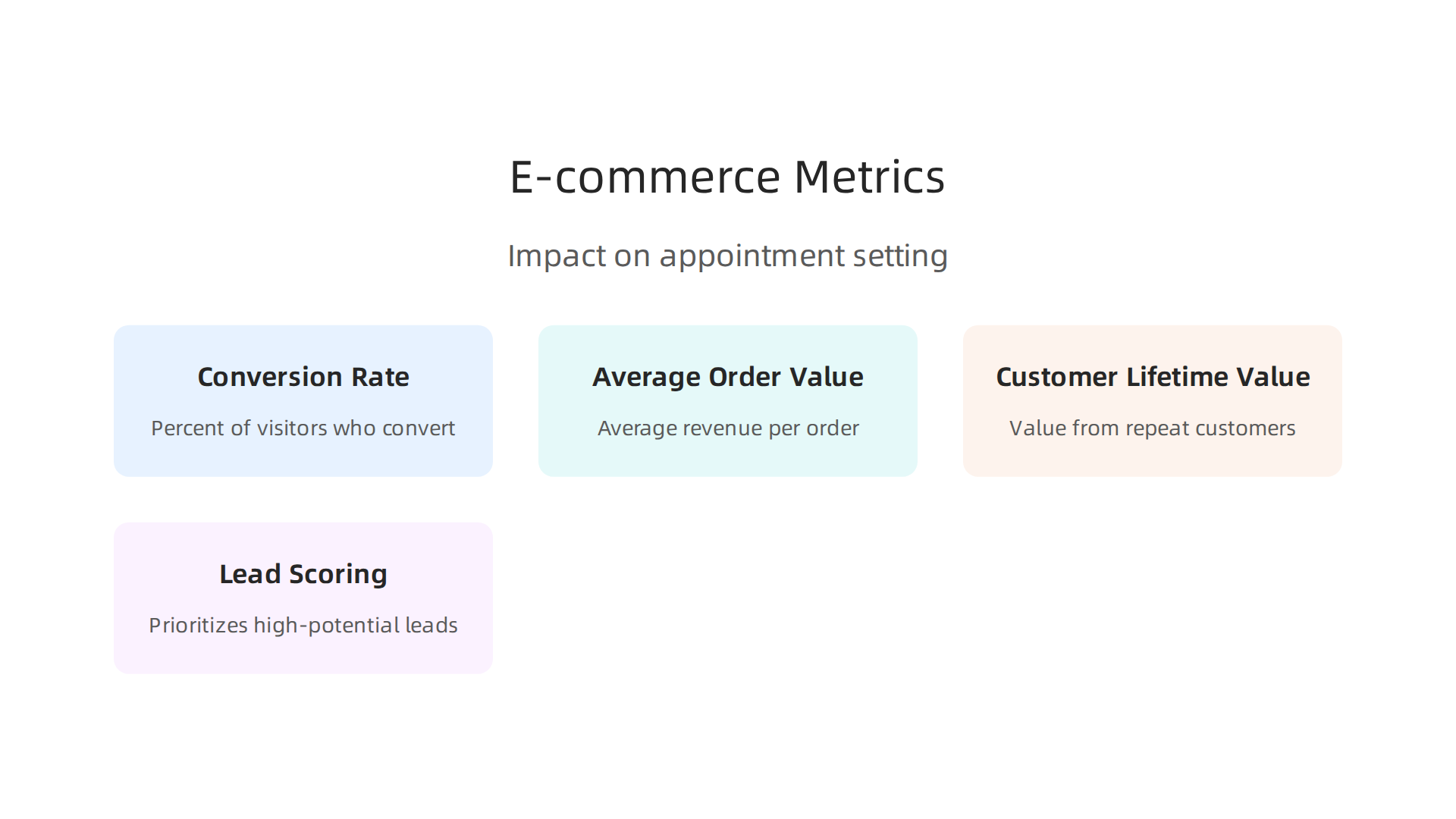
Let’s look at four concepts that matter most.
Conversion Rate
Conversion rate is the percentage of visitors who take a desired action. That could be buying a product, signing up for a newsletter, or booking a call. For an appointment setter, your personal conversion rate is how many of your calls turn into booked meetings.
If you know that the business you work for has a website conversion rate of 2 percent, you understand the pressure. Every lead is precious. You cannot waste time on unqualified people. That is why lead management for appointment setters that boosts conversion rates is such a critical skill. It helps you focus only on the leads that actually convert.
Average Order Value (AOV)
AOV tells you how much a customer spends on average per transaction. In B2B, this number can be huge. Flowlu reports that global B2B ecommerce sales stand at over $32 trillion in 2026. That means the AOV in B2B is often thousands or even millions of dollars.
When you understand AOV, you know which leads are worth extra effort. A high AOV client might take three follow ups to book, but the payoff is massive. A low AOV client needs to be handled quickly to keep your time profitable.
Customer Lifetime Value (CLV)
CLV is the total revenue a business can expect from one customer over the entire relationship. This is huge for appointment setters. If you know a closed deal is worth $50,000 over three years, you will fight harder to get that meeting.
Quantumrun states that global ecommerce sales are forecast to reach $6.88 trillion in 2026. That money comes from repeat customers, not just one time buyers. As a setter, you can use CLV to explain why a lead is worth pursuing even if they are not ready to buy today.
Lead Scoring
Lead scoring is a way to rank prospects based on how likely they are to buy. It uses data like job title, company size, website visits, and past interactions. The International Trade Administration notes that the B2B ecommerce market will grow at a 14.5% compound annual growth rate through 2026. With that kind of growth, you cannot chase every lead. You need a system.
When you combine lead scoring with your knowledge of conversion rates, AOV, and CLV, you become a machine. You know exactly who to call first and what to say.
Why This Matters for Your Career
Clients hire appointment setters who speak their language. When you can say, "I focused on leads with a high CLV and a strong lead score, and I booked four meetings from my top 10 calls," you sound like a pro. That is how you command higher pay and better roles.
If you want to learn more about using these concepts in your daily work, check out Read More for guides on qualifying leads and building your skill set.
Essential Skills for Selling High-Ticket Items in an E-Commerce Environment
You already know the numbers. You understand conversion rates, AOV, CLV, and lead scoring. But knowing those metrics is useless if you cannot apply them in a real conversation. When you sell high-ticket items in an e commerce environment, the stakes are higher. A single appointment can mean thousands or even millions of dollars. That is why you need a specific set of skills to succeed.
High-ticket e commerce is different from selling low-cost products. People do not impulse-buy a $10,000 software package or a $50,000 consulting engagement. They need to trust you. They need to see value. And you need to build that trust without ever shaking their hand. Here are the essential skills that separate top appointment setters from the rest.
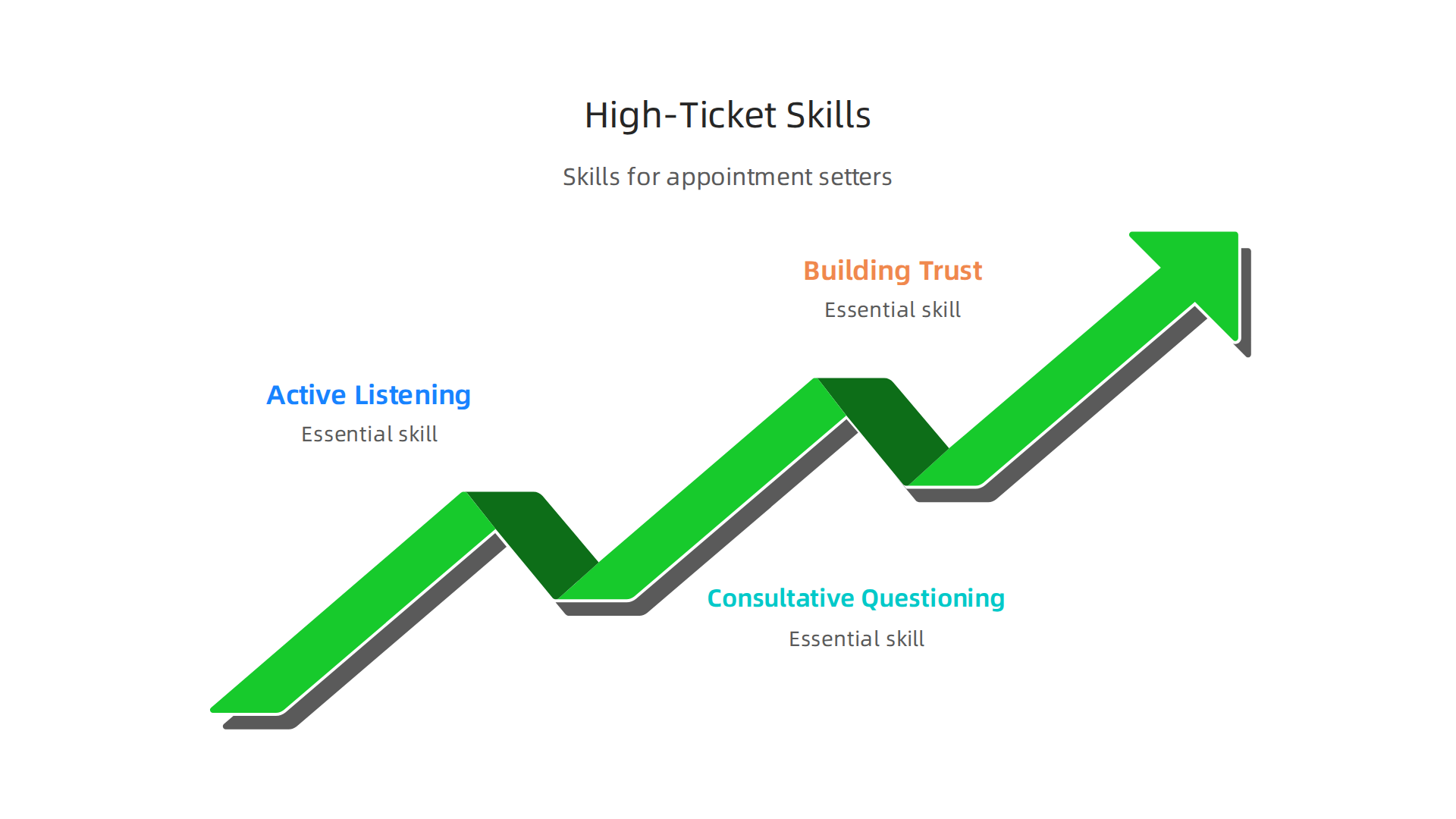
Active Listening and Advanced Communication
The best appointment setters do not talk the most. They listen the most. According to Martal Group, top setters excel in communication and active listening. That means you are not just waiting for your turn to speak. You are really hearing what the prospect says. You pick up on pain points, hesitations, and hidden needs.
In a high-ticket e commerce sale, the prospect might be worried about cost, implementation, or long-term commitment. If you listen carefully, you can address those concerns before they even become objections. This skill is what makes a setter valuable in both B2B and B2C environments. When you understand the true e commerce meaning, you realize it is all about the customer experience, and listening is the first step.
Consultative Questioning
You cannot close a high-ticket deal by reading a script. You need to ask smart questions that uncover what the prospect really wants. This is called consultative selling. Instead of saying, "We have a great product," you ask, "What is your biggest challenge right now?" or "How are you solving this problem today?"
GigaBPO explains that a high ticket setter’s primary role is to qualify leads and warm them up for a closer. To do that well, you must use consultative judgment. You need to know when to push and when to pull back. This is especially important in B2B meaning business-to-business sales, where decisions involve multiple stakeholders.
Handling Price Objections Confidently
High-ticket items come with high price tags. You will hear objections like "That is too expensive" or "We do not have the budget." Your job is not to argue. Your job is to reframe the value. If you know the CLV and AOV from the previous section, you can say something like, "I understand the upfront cost seems high. But based on what you shared, this solution can pay for itself within three months."
Many appointment setter jobs, like the ones listed on Indeed, require you to handle objections gracefully. Practice phrases that acknowledge the concern and redirect to value. That is how you keep the conversation moving.
Technical Proficiency with CRM Tools
You cannot manage high-ticket leads on sticky notes. You need a CRM. Top appointment setters are comfortable using tools to track calls, log notes, and set reminders. Martal Group also lists technical proficiency as a key skill. If you know how to use a CRM effectively, you can prioritize leads with the highest lead scores and follow up at the right time.
Digital literacy also means using email templates, scheduling tools, and video conferencing platforms without fumbling. In a remote e commerce environment, first impressions happen on the screen. Make sure you look professional.
Building Trust Without Face-to-Face Contact
The hardest part of remote high-ticket sales is building trust. You cannot rely on a firm handshake or a nice office. You must build trust through your words and actions. Be consistent. Follow up when you say you will. Show that you understand their industry. Share case studies or testimonials when appropriate.
If you want to master these skills, start by practicing one at a time. Listen more on your next call. Ask one better question. Handle one objection calmly. Progress happens fast when you focus.
For more strategies on becoming a trusted appointment setter, Browse Guides on our blog. You will find scripts, tips, and frameworks that help you sell high-ticket items with confidence.
Navigating Compensation and Career Growth in E-Commerce Sales
So you have built the skills. You can listen, ask smart questions, and handle objections with confidence. Now comes the part everyone wants to know about: how much can you actually make? And where does this career lead?
The answer depends on the model you work in. In B2B (business-to-business) e-commerce, compensation often comes as a base salary plus commission. In D2C (direct-to-consumer) or performance-only roles, you might earn straight commission with no base. Understanding this B2B meaning helps you pick the right path.
Realistic Income Expectations for 2026
Let’s look at real numbers. According to Wow Remote Teams, the average appointment setter in the U.S. earns between $45,000 and $46,400 per year in 2026. Martal Group reports that top-decile earners make around $78,000. And PayScale shows hourly rates range from $12 to $21, plus bonuses and commissions.
But here is the thing: high-ticket e-commerce sales change the game. When you sell expensive products or services, commissions are larger. Many appointment setter jobs, like those listed on Indeed, offer a base salary up to $50,000 with uncapped commission. That means your earnings can grow fast if you perform well.
Multiple income streams are also possible. Some setters combine a base salary with commissions from appointments they book. Others work multiple part-time roles or even start their own online business ideas from home by becoming independent contractors. If you want extra income, affiliate programs for beginners can be a great side hustle while you build your main career.
Career Path: From Setter to Sales Leader
The best part? Appointment setting is not a dead-end job. It is a starting point with real upward mobility.
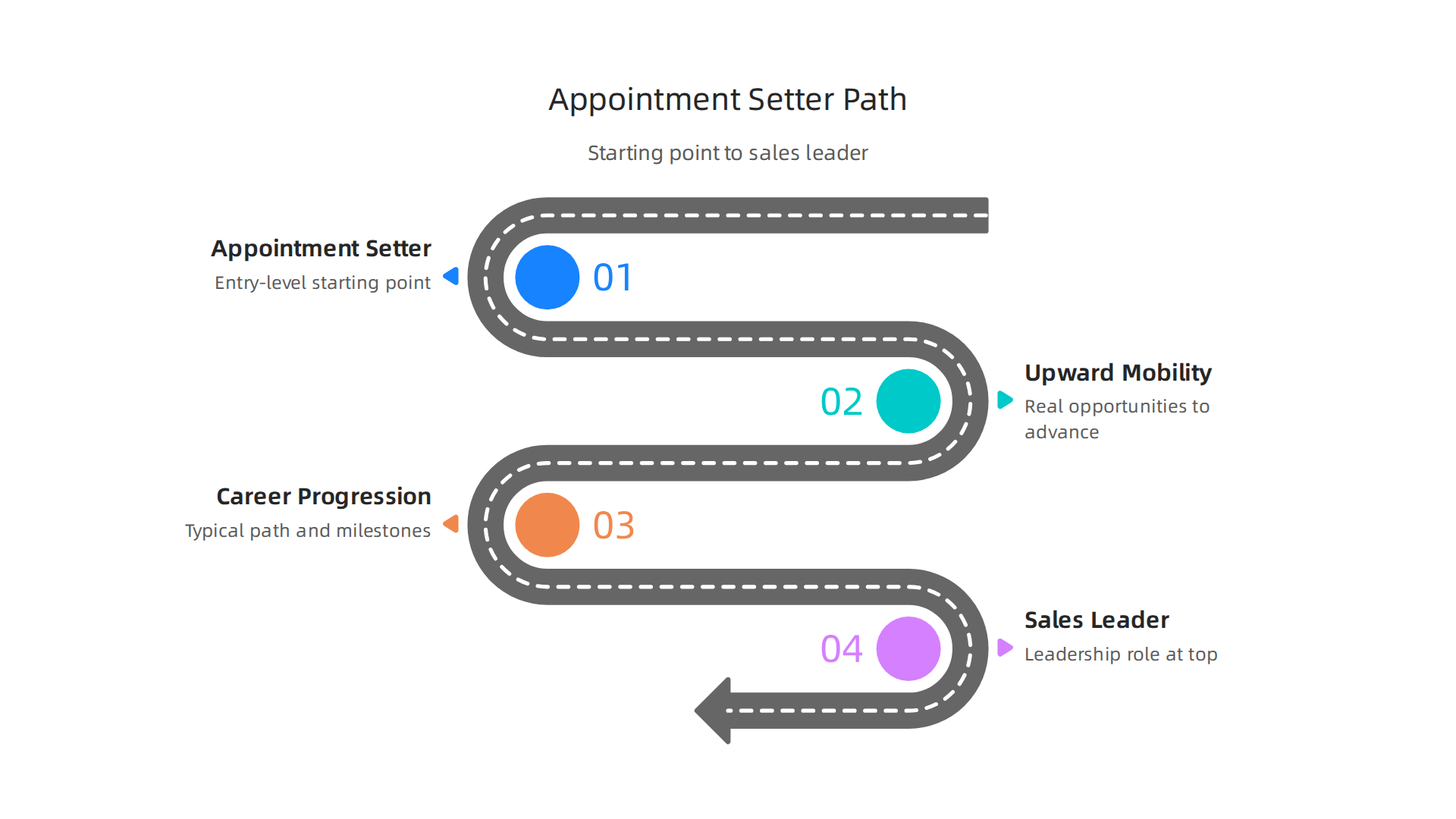
Many successful sales leaders began as setters. The typical path looks like this:
- Appointment Setter – You book qualified meetings and learn the sales process.
- Sales Development Representative (SDR) – You handle early-stage prospecting and qualification.
- Account Executive (AE) – You close deals and manage client relationships.
- Sales Manager – You lead a team and drive strategy.
Each step brings higher base pay, bigger commissions, and more responsibility. The eCommerce Salary Guide 2026 shows that senior roles in e-commerce, like Director of eCommerce, can earn well over $100,000.
If you want to see how appointment setters turn skills into a solid career path, check out our guide on breaking into niche sales roles. It covers specific industries where setter experience is highly valued.
Take the Next Step
You now know the skills and the earning potential. The only thing left is action. Whether you aim for a base-plus-commission B2B role or a performance-only D2C gig, the opportunities are real.
Ready to explore more strategies and find the right path for you? Browse Guides on our blog for scripts, training tips, and career insights that help you grow in e-commerce sales.
Overcoming Remote Work Challenges as an E-Commerce Appointment Setter
Remote work sounds like a dream. No commute. Flexible hours. Your own space. And for many appointment setters, it really is a great setup.
But here is the truth nobody tells you right away: working from home comes with its own set of tough challenges. And if you are not ready for them, they can hurt your performance and your income.
A recent study found that about 20% of remote professionals say communication and cooperation are their biggest hurdles. And 86% of fully remote employees report feeling burnout. That is a serious number. The flexibility of remote work can blur the lines between your job and your personal life fast.
So let’s talk about the three biggest remote work challenges for e-commerce appointment setters in 2026 and how to beat them.
Challenge 1: Isolation and Lack of Peer Support
When you work alone at home, you miss the energy of a sales floor. No high fives after a good call. No quick feedback from a manager walking by. This isolation can drain your motivation over time.
The fix? Build your own support system. Join online accountability groups for sales pros. Use coworking spaces or virtual co-working sessions. And stay active in communities where other setters share tips and wins.
Challenge 2: Time Management and Distractions
At home, the laundry calls. The fridge calls. Your phone buzzes with notifications. It is easy to lose focus and waste hours.
The best appointment setters use structured routines and tools to stay on track. Many use CRM automation to handle follow-ups and lead tracking so they can focus on actual calls. Setting clear work hours and sticking to them is also key. Check out our guide on lead management for appointment setters that boosts conversion rates to see how the right system saves you time.
Challenge 3: Burnout and Blurry Boundaries
When your office is your living room, it is hard to clock out. You might answer emails at 10 PM or take one more call after dinner. This leads to burnout fast.
Set hard boundaries. Create a dedicated workspace. When your workday ends, close your laptop and walk away. Use a simple ritual to signal the end of work, like changing your clothes or going for a walk.
Build Skills to Stay Competitive
Remote work also means you need to keep learning. The world of B2B and B2C e-commerce changes fast. New tools and AI agents are reshaping how sales teams operate. Staying ahead means investing in your skills regularly.
Want to discover practical training and strategies that help you thrive? Browse Guides on our blog to find resources that keep you sharp and successful in your remote role.
Summary
This article explains what e-commerce really means for appointment setters and shows how understanding models, metrics, and buyer behaviour makes you more effective. It defines B2C, B2B, D2C and marketplace businesses and explains how each model changes your questions, qualification process, and follow-up. You’ll learn the four key metrics—conversion rate, average order value (AOV), customer lifetime value (CLV), and lead scoring—that help prioritize high-value prospects. The guide also covers the specific skills needed to sell high-ticket offers remotely, including active listening, consultative questioning, objection handling, and CRM proficiency. Compensation ranges and realistic 2026 income figures are discussed so you can choose the right role or commission structure. Finally, the piece addresses common remote-work challenges like isolation, time management, and burnout, and offers practical fixes to stay productive. After reading, you’ll be able to tailor your outreach by model, qualify leads faster, and position yourself for higher-value appointments and career growth.